

Religious Education
Mission Statement for Religious Education
As a voluntary aided Church school, Religious Education (RE) is central to nurturing our school’s ethos. We believe Christian principles are as much caught as taught, and we strive to embody these principles daily. Our school environment is permeated with worship, tolerance, respect, concern for the less fortunate, thankfulness, and friendship—preparing every child to step confidently into God’s world with understanding and compassion.
Aims of Religious Education
The aims of RE in Church schools are to:
- Enable pupils to know and understand Christianity as a living faith that shapes lives globally and has profoundly influenced British culture and heritage.
- Enable pupils to learn about other major world religions and worldviews, appreciating their impact on society and culture, and to express their own ideas and insights.
- Support pupils’ spiritual and philosophical development by encouraging exploration and enrichment of their own beliefs and values.
RE Statement of Entitlement (Church of England Education Office 2026)
All pupils can expect:
- RE to be a high-profile subject and a priority for those who lead their school.
- To be enabled to achieve highly in RE, irrespective of educational need or disadvantage. A sequenced curriculum where they will learn about a range of religious and non-religious worldviews and the diversity that exists within those worldviews.
- A balanced curriculum, using high-quality resources, where they engage with a range of ways of knowing, including theology, philosophy and the human and social sciences.
- Teachers who have secure RE subject knowledge and are able to deliver content accurately whilst having the ability to challenge common misconceptions.
- RE to be delivered in an objective, critical and pluralistic manner.
- RE classrooms which are safe, supportive spaces where pupils can openly explore their own religious, spiritual, and/or philosophical ways of living, believing, thinking, and belonging.
- To be given the opportunity to articulate their personal worldviews and engage in meaningful, respectful dialogue with others.
- RE teaching which promotes religious and cultural understanding within communities and society.
Parents can expect:
- RE to be an expression of the school’s theologically rooted Christian vision and a priority for those who lead their child’s school.
- RE to be a high-profile academic subject, distinct from collective worship and non-confessional in nature.
- RE provision to reflect the Anglican foundation on which the school is established (i.e. according to its trust deed or academy funding agreement).
- Christianity to be the main religious worldview studied in and through RE in each year group/phase equating to at least 50% of curriculum time.
- A range of religious and non-religious worldviews to be studied.
- An RE curriculum to be offered for all pupils in all statutory year groups.
Multi academy trusts with Church schools will ensure that:
- RE has a high priority as an academic subject.
- Appropriate systems are in place to monitor and evaluate standards in RE effectively in all Church schools within their trust.
- Senior leaders in Church schools are supported and enabled to prioritise RE in accordance with this statement of entitlement.
- The RE curriculum in place meets the expectations set out in the school’s funding agreement.
- Subject knowledge and subject leadership are developed, to enable high-quality teaching and learning in RE.
- They look towards the expertise provided by their diocese for support and guidance with RE.
Leadership and Accountability
As a voluntary aided school, the leadership of RE is a distinctive responsibility of the School Committee and Headteacher. The Headteacher oversees monitoring, evaluation, and development planning for RE. RE is delivered in accordance with the Trust Deed and the doctrines of the Church of England. While RE and Collective Worship complement each other, they are managed separately, each with its own policy.
Religious Education Curriculum
RE lies at the heart of the curriculum at St. Ann’s Church of England School:
- We follow the Liverpool Diocesan Board of Education Syllabus (Questful RE), aligned with the National Framework for RE, supplemented by Understanding Christianity (Church of England Education).
- At least 5% of curriculum time is dedicated to RE.
- RE is taught as a discrete subject in Key Stages 1 and 2, and integrated within the Foundation Stage Framework (1 hour/week).
- Christianity is central, comprising two-thirds to three-quarters of RE teaching time.
- Teaching about other faiths (Islam, Hinduism, Judaism, Sikhism) is included, often through World Faith Focus Days.
- Our curriculum balances explicit teaching of Christian concepts and God’s salvation story with an open, investigative enquiry approach. Pupils engage with probing questions that encourage reflection, evaluation, and meaning-making, helping them explore their identity, relationships, and spirituality.
Teaching and Learning in RE
Teaching will:
- Critically engage with a range of religious and non-religious source materials, including biblical texts.
- Utilise different disciplinary lenses, including theology, philosophy and the human and social sciences.
- Provide opportunities to understand the roles of texts, beliefs, rituals and practices and how they help form identity in a range of religious and non-religious worldviews. Pupils should explore how beliefs, rituals and practices may change in different times, places, communities and cultures.
- Develop confident religious literacy, including the explicit teaching and development of disciplinary knowledge.
- Generate meaningful and informed dialogue around a range of religious and non-religious worldviews.
- Recognise that students bring personal knowledge to the RE classroom and enable them to navigate and develop this.
- Practise a wide range of skills including enquiry, analysis, interpretation, evaluation and reflection.
- Provide for the needs of all pupils, including pupils with special educational needs and disabilities.
- Be based upon accurate and inclusive assessment of the different forms of knowledge, which enables pupils to make progress in their learning.
Christian Distinctiveness
As an Anglican school, we provide:
- A culture of mutual respect where pupils and staff can openly share beliefs without fear of ridicule.
- Safe spaces for all pupils, including those from Christian and other faith backgrounds, to explore faith, doubt, and certainty.
- Opportunities to experience the Church’s year, visit places of worship (local parish church, Anglican Cathedral), and engage with community faith leaders.
- Access to Christian artefacts, prayer spaces, and age-appropriate Bibles.
- Varied worship experiences, including hymn singing and spiritual songs.
- Support to develop religious language confidence and knowledge of Christianity as a global, multi-denominational faith.
- Excellent progress in pupils’ understanding of Christianity.
Spiritual, Moral, Social and Cultural Development (SMSC)
RE significantly contributes to pupils’ SMSC development:
- Spiritual: Encouraging discovery of God, self-awareness, and wonder at creation.
- Moral: Grounded in Jesus’ teachings, providing a foundation for ethical decision-making.
- Social: Understanding living in a Christian community based on love and respect.
- Cultural: Appreciating Christianity as a worldwide faith impacting millions.
- Spirituality at St Ann’s is understood as relationships with God and others, nurtured through collective worship, reflection, prayer, and opportunities to explore big questions like “What would Jesus do?” This is supported through a rich curriculum and varied experiences, including worship services, confirmation classes, prayer spaces, and community events.
Diversity and Inclusion
RE at St. Ann’s Church of England Primary School equips pupils to appreciate the common human quest for truth and relationship with the divine. We foster respect for all major world faiths, grounded in accurate understanding and consistent with our Christian foundation. Pupils learn about other faiths through encounter and dialogue, recognising common beliefs and practises while enriching their own faith.
SEND Provision
We are an inclusive school, ensuring RE is accessible to all pupils. Work is adapted, and pupils participate through diverse media such as story, art, music, drama, dance, and technology.
Assessment
Assessment for Learning underpins all RE lessons, with clear objectives shared at the start. Opportunities for questioning, reflection, peer, and self-assessment are integral. Ongoing assessment records pupils’ progress as:
- Working towards expected standards
- Working at expected standards
- Working at greater depth within expected standards
Parental Rights of Withdrawal
The Worship and Religious Education provided reflect the Church of England foundation that permeates the curriculum and school life. While parents have a legal right to withdraw their children from RE and Worship, the school’s Christian ethos means that withdrawal cannot fully exempt pupils from the religious life of the school.
Understanding Christianity and God’s Big Story
The following core concepts are explored in the Understanding Christianity approach, as part of the ‘big story’ of salvation, as understood within Christianity.
These eight concepts provide a framework for understanding Christian belief and practice. Through them, pupils explore the Bible and develop an understanding of God, creation, humanity and the relationship between God and his people.
Pupils learn about the Old Testament story, including God’s promises, the People of God and the expectation of a Messiah. They explore the life, teaching, death and resurrection of Jesus and consider how Christians understand his role in God’s plan of salvation.
Pupils also explore the Kingdom of God and what it means for Christians today and in the future. They consider how these beliefs shape Christian lives, including worship, festivals, prayer, compassion, justice, ethical choices and action.
These concepts help pupils to understand the richness and diversity of Christian belief and how Christians seek to live out their faith.
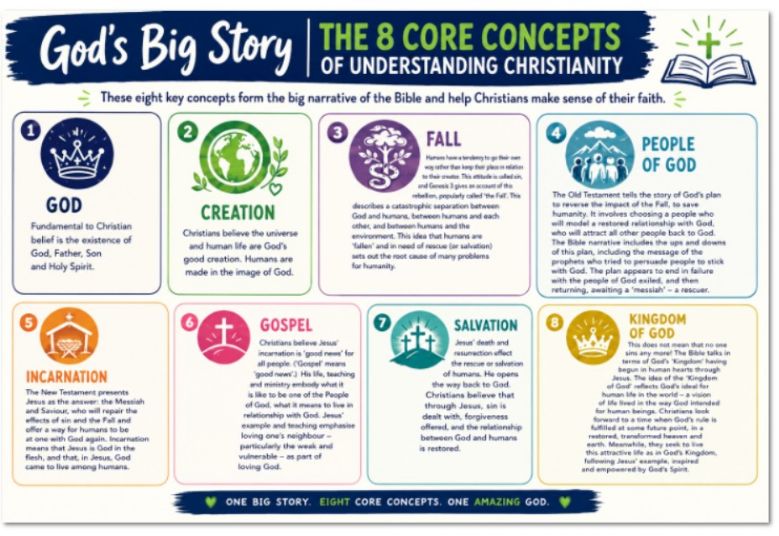
God’s Big Story explained: https://www.youtube.com/watch?v=ebrbdbXzMrg